Cloud & DevOps Services: Bridging Infrastructure Complexity and Developer Velocity
A Comprehensive Blueprint for Building Scalable, High-Velocity, and Secure Cloud-Native Environments

For years, enterprise IT operated under a simple, if painful, dynamic: developers wrote code, pushed it over a figurative wall, and operations teams scrambled to make sure it didn’t crash the servers. Deployments were infrequent midnight events, infrastructure provisioning took weeks of tickets and approvals, and scaling meant ordering physical rack space months in advance.
Today, that operational friction is unsustainable. As digital products become the core driver of enterprise revenue, organizations are under immense pressure to ship features faster while maintaining strict uptime, security, and cost efficiency.
Enter the modern synergy of Cloud Computing and DevOps Services. When executed together, they transform infrastructure from a slow, manual bottleneck into a dynamic, automated asset that accelerates product delivery.
Here is an engineering blueprint exploring how integrated Cloud & DevOps services eliminate operational drag, automate deployment pipelines, and optimize infrastructure spend.
1. The Core Paradigm: Why Cloud and DevOps Are Inseparable
Many organizations fall into the trap of adopting cloud infrastructure without modernizing their operational workflows. Moving virtual machines from an on-premises data center to AWS, Azure, or Google Cloud Platform (GCP)—a process often called "lift-and-shift"—without adopting DevOps principles simply transfers legacy complexity to a more expensive environment.\
Infrastructure as Code (IaC) as the Bridge
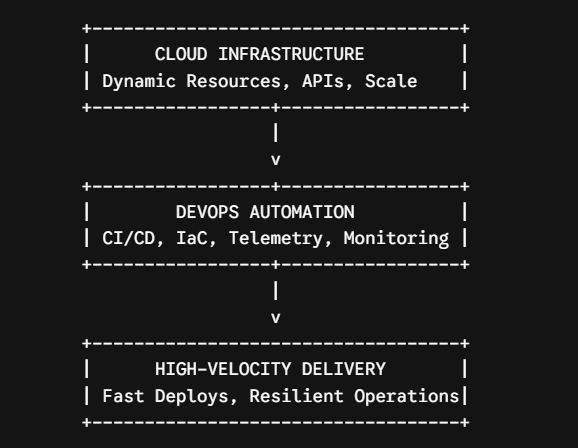
The bridge between raw cloud capacity and DevOps execution is Infrastructure as Code (IaC). By defining cloud servers, network security groups, load balancers, and database clusters using declarative configuration tools like Terraform, Pulumi, or AWS CloudFormation, infrastructure becomes version-controlled software.
Key operational advantages of IaC include:
- Elimination of Configuration Drift: Environments (Development, Staging, Production) are provisioned from the exact same code repositories, preventing "works on my machine" discrepancies.
- Rapid Disaster Recovery: If a regional cloud outage occurs, an entire production environment can be re-provisioned in an alternate cloud region in minutes through automated pipelines.
- Auditability and Governance: Every security rule update or architecture change is tracked via version control (Git) commits, providing a clear audit trail for compliance frameworks.
2. Anatomy of an Enterprise CI/CD Pipeline
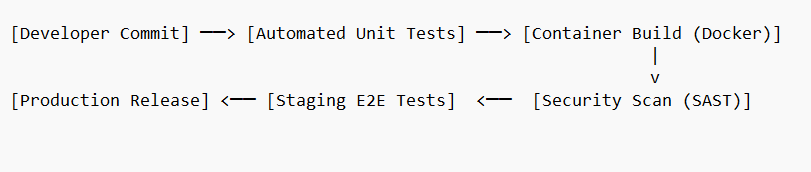
At the heart of DevOps services lies the Continuous Integration and Continuous Deployment (CI/CD) pipeline. A well-designed pipeline automates the journey of code from a developer’s local workstation to production live environments with zero downtime.\
The Stages of Automation
- Automated Testing & Static Analysis: Every git push triggers static code analysis (SAST) and unit tests. If code coverage drops or security vulnerabilities are detected, the pipeline halts immediately.
- Containerization: Applications are packaged into lightweight Docker containers containing their dependencies, runtime libraries, and configurations.
- Registry & Artifact Management: Built container images are cryptographically signed and stored in secure container registries (such as AWS ECR or GitHub Packages).
- Zero-Downtime Deployment Strategies: Advanced deployment patterns—such as Blue/Green deployments or Canary releases—route traffic dynamically using ingress controllers or service meshes (such as Istio). If an anomaly is detected, traffic automatically rolls back to the previous stable release without user disruption.
3. Cloud Cost Optimization: Mastering FinOps
While the cloud offers elasticity, unmanaged cloud architecture can quickly lead to spiraling operational bills. FinOps (Cloud Financial Management) has become a critical discipline within DevOps services to balance engineering agility with fiscal discipline.
Cloud Resource Category | Traditional Unmanaged Cloud | Optimized FinOps Architecture |
Compute Allocation | Over-provisioned static EC2/Compute instances | Autoscaling groups, Spot Instances, & Serverless (Lambda/Fargate) |
Storage Lifecycle | Infinite high-performance SSD retention | Automated lifecycle policies moving cold data to Glacier/S3 Infrequent Access |
Database Scaling | Fixed single-tenant database instances | Serverless databases (Aurora Serverless) with auto-pausing & read-replicas |
Visibility | Monthly surprise cloud bills | Real-time tag-based cost attribution & automated budget alerts |
By implementing continuous cost optimization scripts and automated rightsizing tools, enterprises frequently reduce their monthly cloud spend by 20% to 35% while increasing available computing throughput.
4. Security at Scale: Integrating DevSecOps
Security cannot be an afterthought left for a pre-launch manual audit. In high-frequency release cycles, security must be embedded directly into every phase of the software development lifecycle—a methodology known as DevSecOps.
DevSecOps practices enforce automated guardrails:
- Secret Management: Hardcoded passwords and API keys are strictly removed from repositories. Applications fetch runtime secrets dynamically from dedicated vaults (such as HashiCorp Vault or AWS Secrets Manager).
- Dependency Scanning: Automated tools actively audit open-source libraries for known Common Vulnerabilities and Exposures (CVEs) before code merges.
- Identity and Access Management (IAM): Enforcing the Principle of Least Privilege across cloud services ensures that compromise of a single microservice does not grant access to primary database clusters.
Conclusion
Adopting Cloud & DevOps services is not merely an infrastructure upgrade; it is a fundamental shift in engineering culture. By replacing slow, manual server configuration with automated pipelines, self-healing cloud architectures, and strict DevSecOps governance, organizations eliminate deployment anxiety and unlock sustainable development velocity.
Whether you are refactoring a monolithic application into cloud-native microservices or optimizing a multi-cloud enterprise footprint, mastering the synergy of Cloud and DevOps remains the ultimate blueprint for modern digital resilience.
Scaling Infrastructure with CodvikScribe
Navigating complex cloud migrations, building resilient CI/CD pipelines, and establishing enterprise FinOps practices requires a technology partner with deep engineering expertise.
CodvikScribe is a custom software engineering, cloud architecture, and DevOps consulting agency based in Coimbatore, India. Specializing in cloud infrastructure modernization (AWS, Azure, GCP), Docker/Kubernetes container orchestration, automated CI/CD deployment pipelines, and enterprise DevSecOps, CodvikScribe helps growing businesses and global software teams build secure, production-grade cloud environments engineered for long-term reliability.
References & Further Reading
AWS Cloud Architecture Center
Amazon Web Services. AWS Well-Architected Framework: Reliability, Operational Excellence, and Security Pillars. Available at: https://aws.amazon.com/architecture/well-architected/
The DevOps Handbook
Kim, Gene, et al. The DevOps Handbook: How to Create World-Class Agility, Reliability, and Security in Technology Organizations. IT Revolution Press, 2016.
Google Cloud SRE Guidelines
Beyer, Betsy, et al. Site Reliability Engineering: How Google Runs Production Systems. O'Reilly Media, 2016. Available at: https://sre.google/sre-book/table-of-contents/
Cloud Infrastructure & Enterprise DevOps Solutions
CodvikScribe. Engineering Scalable Cloud Architectures, Microservices, and DevOps Pipelines. Available at: https://codvikscribe.com/
About the author
- CodvikScribe Private Limited is a full-service technology company delivering custom software, mobile apps, AI solutions, and cloud services for startups and enterprises worldwide. One team. One vision. Digital excellence delivered.
Comments
Join the discussionGood, well-structured blueprint — the FinOps table is the most useful part, especially the contrast between monthly surprise bills and real-time tag-based cost attribution, since that is usually where the 20-35% savings you cite actually come from. One addition worth considering: the IaC disaster-recovery point assumes the state and the pipeline themselves survive the region outage, so storing Terraform state remotely with locking and keeping the pipeline definition in Git matters as much as re-provisioning the resources. Same for the canary point — automatic rollback only works if the pipeline has a clear, pre-agreed error-budget signal to trigger on, otherwise it rolls back on noise. Solid overview overall.